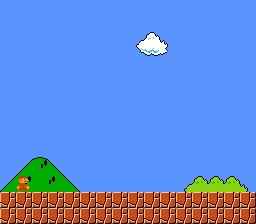
Multi-speed horizontal scrolling using HDMA – one background image, three scroll zones.
What This Example Shows
- Splitting the screen into horizontal zones with different scroll speeds
- Using HDMA to update BG1HOFS per scanline group
- Creating a depth illusion with a single background layer
- Updating HDMA table values at runtime from C
Controls
No interactive controls. The background scrolls automatically in three horizontal bands at different speeds.
Build & Run
Then open parallax_scrolling.sfc in your emulator (Mesen2 recommended).
How It Works
The Parallax Technique
Real parallax scrolling uses multiple BG layers at different speeds. This example achieves the same depth effect with a single layer by using HDMA to change the horizontal scroll register at different screen positions.
The screen is divided into three zones:
| Zone | Scanlines | Speed | Visual |
|---|---|---|---|
| Top | 72 lines | +1 px/frame | Stars/sky (distant, slow) |
| Middle | 88 lines | +2 px/frame | Midground pattern |
| Bottom | 64 lines | +4 px/frame | Grass/ground (close, fast) |
HDMA Scroll Table
The HDMA table lives in RAM so it can be updated each frame:
HDMA Setup
The hdmaParallax() function configures HDMA mode 1REG_2X on the specified channel, targeting the BG horizontal scroll register. Mode 1REG_2X writes 2 bytes to the same register – the low byte and high byte of the scroll position.
Animation Loop
Each frame, the main loop increments the scroll offsets at different rates:
Because the table lives in RAM, the HDMA hardware reads the updated values on the next frame automatically.
SNES Concepts
BG1HOFS ($210D) – Write-Twice Register
BG scroll registers on the SNES are "write-twice" latched registers. You write the low byte first, then the high byte, both to the same address. HDMA mode 1REG_2X handles this automatically by writing 2 bytes per entry to the target address.
64x32 Tilemap for Seamless Wrapping
The example uses a 64x32 tilemap (512 pixels wide). When the scroll offset exceeds 512, the tilemap wraps seamlessly because the PPU performs modular addressing on the tilemap. This is wider than the screen (256 pixels), so there is always enough off-screen content to scroll into.
Why This Works with One Layer
In a true multi-layer parallax, BG1 and BG2 have independent scroll registers. But HDMA can rewrite BG1HOFS at different points during the frame, effectively giving each screen zone its own scroll speed. The limitation is that you cannot overlap the zones – each zone is a strict horizontal band.
Project Structure
| File | Purpose |
|---|---|
main.c | HDMA table setup, per-frame scroll updates |
data.asm | Background tiles, tilemap, and palette data |
res/back.png | Source background image (512 pixels wide) |
Makefile | LIB_MODULES := console dma background sprite hdma input math |
Going Further
- Player-controlled scroll: Replace the automatic scroll with D-pad input. Only increment the offsets when a direction is held.
- More zones: Add more entries to the scroll table for 5-6 speed zones. The HDMA table just needs more
[count][lo][hi]entries before the terminator. - Explore related examples:
backgrounds/continuous_scroll– True multi-layer parallax with player controleffects/hdma_wave– Another HDMA technique (per-scanline wave distortion)