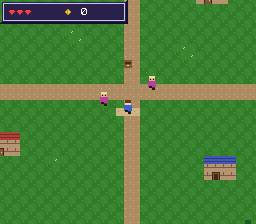
Screenshot
The SDK's modules composed into a playable RPG skeleton. Two things make it a template rather than a demo:
1. The map is a real Tiled map. res/town.tmj holds the terrain, the per-tile collision (each tile's attribute property), the entity positions (the Entities object layer: spawn, villagers, chest) and each villager's line of dialogue (a text property on the object). Adding a villager is a map edit, not a code edit. None of it is hardcoded — open the map in Tiled, edit it, re-run the generator, rebuild. The map is validated by the SDK's own tmx2snes converter.
2. A real bordered dialog box, and a HUD. Both are 9-slice panels on BG2 with their text on BG3 above — the classic SNES RPG window, with the layers stacking scene < panel < text. The HUD carries hearts and a purse; the purse goes up by 10 when you open the chest.
3. Two scenes. The town, and the inside of the blue-roofed house. A scene is a tileset + a palette + a tilemap + a collision map + entities, and the interior is its own Tiled map (res/house.tmj) with its own 16-colour palette — neither scene gives up colours for the other. Walking onto the door swaps all five; the host greets you with no button press.
| Input | Action |
| D-pad | walk (one tile per step) |
| A | talk to a villager (face it) / open the chest (step on it) |
| walk into the blue door | enter the house; the mat inside takes you back |
ROM mode: LoROM (project default).
SNES Concepts
- Tiled as the content pipeline: collision and entities are data. gen_assets.py reads town.tmj and emits the SNES tilemap, a 64×64 collision map and entities.inc.
- Tile-exact collision: the hero occupies one tile; its 16×16 sprite is drawn straddling that tile (feet on it, body overhanging upward) — the standard top-down convention. Drawing the sprite at the tile corner instead puts the visible body half a tile from what collides, which reads as random "too early / too late" blocking.
- Several characters, one sprite sheet: the villagers reuse the hero's tiles with a second OBJ palette — recolored, not redrawn. The sheet is converted with -s 16 because it holds 16×16 frames (see docs/tutorials/sprites.md).
- The plan owns the sprite-palette slots: res/palettes.toml lists the OBJ palettes; the build runs opensnes-palette plan (see docs/tools/opensnes-palette.md) to assign each a collision-free CGRAM slot and generate res/palettes.inc. main.c uses PAL_HERO_CGRAM / PAL_NPC_CGRAM and the matching _SLOT for the OAM palette field, so adding a villager never desyncs the code from the layout — no hand-counted 128 / 144. The BG palettes stay hand-managed on purpose: the two scenes swap the same slot 0 and the text layer owns slot 1 at runtime, a dynamic layout a static plan does not model.
- Off-camera entities must be hidden, not just drawn: OAM X is 9 bits and Y is 8, so an entity outside the camera does not vanish — its coordinates wrap and it reappears somewhere plausible, e.g. a villager standing inside the town wall. draw_char() parks anything off-camera at OBJ_HIDE_Y.
- Forced blank, not brightness 0, around a big VRAM upload: setScreenOff() sets INIDISP bit 7, the only state besides VBlank in which the PPU accepts VRAM writes. setBrightness(0) just makes the screen black — the PPU keeps fetching and the write is dropped. The 2 KB dialog panel got away with it because it happened to land inside VBlank; the 8 KB town tilemap on the way out of the house did not, and came back as garbage.
- A fixed 16-colour palette per scene, authored by hand instead of quantised from RGB. With a quantiser, adding one tile re-derives the whole palette and every existing tile shifts hue — the town's paths turned pink the first time the blue roof was added.
- Two 9-slice panels on one layer via the panel module: the HUD at the top and the dialog box at the bottom share BG2's tilemap, so one upload covers both and opening a dialog never disturbs the HUD. The module does that upload under forced blank, which is the part that is easy to get wrong. text_config.priority plus BGMODE bit 3 put the text in front of the opaque town.
- Collision through the SDK's collideTile() over the Tiled map. Its tilemap parameter is const, so the lookup is a bank-honouring far read (#121) — the 4 KB map needs neither bank $00 nor a byte of RAM.
Editing the map
# open res/town.tmj in Tiled, edit terrain / drag the Entities objects
python3 gen_assets.py --keep-map # re-read town.tmj + house.tmj, rebuild
make
Tile collision is the attribute property on each tileset tile (FF00 = solid, 0 = walkable). Entities are objects in the Entities layer, typed spawn, npc or chest. An npc blocks its tile (you talk face-to-face) and carries its dialogue in a text property; a chest does not block (you step onto it).
Run python3 gen_assets.py without --keep-map to regenerate the whole map from the script's layout.
town.tmj is a standard Tiled map, so the SDK's own converter reads it too — a useful check that the file is well-formed:
../../../bin/tmx2snes -e -Q res/town.tmj res/tileset.map
-Q writes the quadrant-ordered 64×64 tilemap this example scrolls with the background module, and -e writes the entities as C defines — byte-identical to what gen_assets.py produces. The generator still runs the conversion itself because it also builds the per-cell collision grid and marks the villagers' tiles blocked, which is game logic rather than map data; moving the rest onto the tool is a Makefile change.
How to Build
Modules Used
console, dma, background, sprite, text, input, collision, panel

 1.16.1