 |
OpenSNES
Modern Open-Source SNES Development SDK
|
|
OpenSNES
Modern Open-Source SNES Development SDK
|
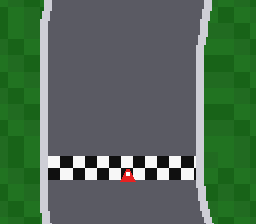
A drivable race circuit on the Mode 7 plane (#4, part 1). The car stays fixed low on screen and the world rotates and scrolls under it — the classic SNES racing camera, driven per frame by the C-migrated mode7 module (mode7SetAngle + SetCenter + SetScroll).
| Input | Action |
|---|---|
| D-pad left/right | steer |
| A | accelerate |
| B | brake |
Grass slows the car to a crawl; the red border wall is solid. The track (rounded rectangle + chicane, checker start line) is generated at build time by gen_track.py (committed, deterministic) and converted by opensnes-tileset with mode = 7 in res/track.png.toml.
ROM mode: LoROM (project default).
(Regenerate the track: python3 gen_track.py, then make.)
console, dma, background, sprite, math, mode7, input
 1.16.1