Family 5 (Game math & framework) · a panel building block.
Why it matters for your game
Every game has furniture: a status bar with hearts and a coin count, a dialog box that opens over the world and closes again. Both are the same primitive — a 9-slice panel, a bordered box stamped from a 3×3 tile sheet (four corners, four edges, one fill). Without a helper it's ~60 lines of stamping loop and priority wiring per box; the panel module is that loop, done once and correctly, so your game code just says draw a box here.
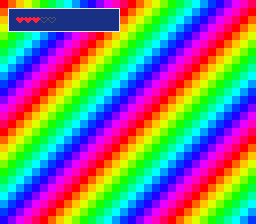
Screenshot
What you'll learn
The single new idea: the panel module — several boxes, one layer, one upload. The HUD and the dialog live in the same tilemap on the same BG layer. panelDraw() stamps a box (picking corner/edge/fill by position); panelPut() drops a single sheet tile — a heart icon — into it; panelFlush() uploads the whole map. Opening the dialog is panelDraw + panelFlush; closing it is panelClear + panelFlush; and the HUD is untouched either way.
Two things worth internalising:
- You own the tilemap. panelInit() takes your 32×32 buffer rather than allocating 2 KB behind your back — a quarter of the 8 KB C RAM band — so the cost stays visible. panelInit() fills it with entry 0, so tile 0 must be transparent (here the colourful BG1 shows through it).
- panelFlush() is forced-blank — use it for structure, not the HUD. It pushes the whole 2 KB map, so it wraps the DMA in real forced blank (setScreenOff/setScreenOn) and briefly blanks the screen. That is fine for a dialog box opening (a deliberate moment), but running it every time a heart changes would blink the top of the screen on every hit. So the hearts — which change often — upload only their own 64-byte tilemap row with an ordinary VBlank DMA (flush_hud_row): no forced blank, no flicker. The rule: panelFlush for structural changes, a small VBlank DMA for a frequently-updated HUD.
The border and heart icons are generated in C — zero assets.
What to observe / if it breaks
- Correct run: a HUD box with 3 filled + 2 empty hearts sits over a rainbow background. B loses a heart, A gains one, START opens/closes a dialog box lower down — and the HUD never flinches when the dialog appears.
- Corners/edges tiled everywhere instead of one box: tile 0 isn't transparent, so panelInit's blank entry is drawing a real tile. Keep the 9-slice at base_tile ≥ 1 and leave tile 0 empty.
- The box is opaque black / hides the background: the fill palette entry, not transparency — only pixel value 0 is transparent; the fill uses a real colour on purpose.
- Top of the screen blinks dark when hearts change: you're calling panelFlush() for the HUD. Its forced blank overruns into the first scanlines. Push just the changed row with a small VBlank DMA instead (flush_hud_row); keep panelFlush for the dialog.
Probe oracles: hero_hp (0–5, hearts shown) and dialog_shown (0/1).
Build & run
make
../../../testing/bin/luna run -n 3000000 panel_hud.sfc
Modules used
console, dma, background, panel, input, tile (tileEncode4bpp)
Where you are
Uses the panel module in isolation. For a full game that combines it with text in the box (dialog lines, a numeric score), see games/rpg.

 1.16.1