OpenSNES
Modern Open-Source SNES Development SDK
Loading...
Searching...
No Matches
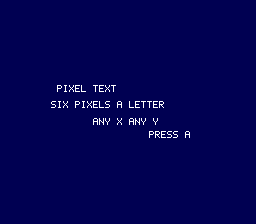
Pixel Text
Screenshot

Four lines of a narrow font at a 6-pixel pitch, none of them on the tile grid, composed in RAM and sent to VRAM: the text module puts one glyph per tile, and a game that wants proportional text, or a label at any x and y, composes its own 2bpp layer. The primitive is tileBlitGlyph2bpp(), which ORs rows of a glyph into one tile and the tile to its right at a pixel shift; two calls per glyph cover the four tiles a glyph at (x, y) can touch. Press A and every line moves one pixel right, the glyphs crossing tile boundaries as they go. No assets: a 5x7 font declared as bits becomes 2bpp glyphs at boot.

SNES Concepts

  • A 2bpp tile is 16 bytes, planes 0 and 1 interleaved per row. A layer of 160 tiles is 2560 bytes in FAR RAM, and tile n of the layer is tile n of the sheet in VRAM: the tilemap only places the tiles, the pixels are whatever the layer holds.
  • A glyph at x covers tile x / 8 and, shifted by x % 8, the tile after it; at y it covers rows y % 8 to 7 of one tile row and rows 0 to y % 8 - 1 of the next. The slot to the right is the next tile of the layer, the slot below is one row of tiles further.
  • The call only ORs, so the layer is cleared with memset() before a new layout, and glyphs may overlap.
  • After a change the layer goes to VRAM in two halves of 1280 bytes, one per VBlank, inside the DMA budget of a frame.
  • Cost: about 12 000 master cycles a glyph for its two calls (measured on luna), where the same work in C costs 40 000 to 50 000.

Controls

Button Action
A Shift every line one pixel to the right (six steps, then back)

How to Build

make

Modules Used

console, dma, background, input, tile, string