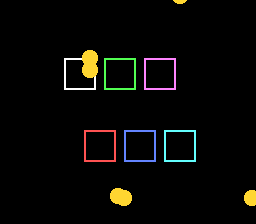
Screenshot
Seventeen coins drift over a 512 × 448 world, six square walkers pace up and down near its centre, and the D-pad scrolls a 256 × 224 view of it. Every frame the example hands its world-space arrays to oamPlaceWorld(), once per batch: the call subtracts the camera, hides what is off screen, writes the OAM entries and the ninth x bit, and reports in visible[] which sprites it placed — the loop a scrolling game runs every frame, in assembly. The walkers are sorted by depth and the batch's order says which walker each slot shows, the way a game sorts twenty players on a pitch.
SNES Concepts
- World coordinates minus a camera give screen coordinates; a sprite partly off the left edge needs the ninth x bit (x in 256..511), which the PPU reads as negative.
- OAM culling: a sprite off screen is hidden (x = 257, y = 240), not left where it was.
- OAM order is drawing order: the lower slot is in front. Seen from above, the sprite lower on the screen is nearer, so the walkers are sorted by y every frame (an insertion sort of six bytes) and order permutes the slots — the arrays stay indexed by the walker, nothing is copied.
- Structure of arrays (one array per property) is what the 65816 indexes cheaply; an OamWorldBatch is filled with their addresses once.
- A batch has one size: the coins are the SMALL size of OBJ_SIZE16_L32 (16 × 16), the walkers the LARGE one (32 × 32), set once with oamSetSize(): the call never touches the size bit.
- visible[] tells the game which sprites were placed — here it counts the coins in view; a game reads it to stream the animation frames of the sprites that are shown and skip the others, so that a sprite off screen costs no VRAM DMA.
- A batch costs the same whether its sprites are on screen or not (the call tests each one); a game that hides a whole group skips the call with a flag of its own rather than placing hidden sprites.
Controls
| Button | Action |
| D-pad | Scroll the camera |
How to Build
Modules Used
console, dma, background, sprite, input, tile

 1.16.1