 |
OpenSNES
Modern Open-Source SNES Development SDK
|
|
OpenSNES
Modern Open-Source SNES Development SDK
|
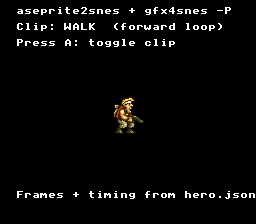
An animated 32×48 metasprite — Kit, the fox-kit courier — whose every byte of data is generated from an Aseprite export — no hand-written frame tables, no hand-typed animation clips. This is the working reference for the two-tool sprite pipeline:
sheet owns the pixels and the metasprite geometry; anim owns the timeline (tags, per-frame durations, direction). They meet at the frame value: a clip's frame i selects hero_metasprites[i], resolved inline by animTickMeta() and drawn with oamDrawMetasprite().
The sheet holds eight frames and two tags — walk (frames 0-3, forward loop) and wave (frames 4-7, ping-pong) — with per-frame millisecond durations. opensnes-sprite anim converted those to ticks and folded the ping-pong into the frame order (4, 5, 6, 7, 6, 5). Press A to toggle between the two generated clips.
res/hero.png and res/hero.json are what Aseprite writes with --sheet hero.png --data hero.json --list-tags (the JSON-array form). Here they are made by devtools/art_assets/build.py from characters/kit_tall_sheet.png: Kit drawn by PixelLab at 32×48, his walk and his wave animated by its animate-with-text-v3 (CC0, assets/neo-lumen/README.md). A real .aseprite project exported with those options gives the same two files.
The build runs the full pipeline from the two settings files beside the assets (res/hero.png.toml, res/hero.json.toml): opensnes-sprite sheet and opensnes-sprite anim, then the generated assets_gen.asm links the tiles, then main.c compiles (it #includes both generated headers). No data.asm, no conversion rule in the Makefile (docs/tools/CONVENTIONS.md).
console, sprite, dma, text, text4bpp, background, input, anim
 1.16.1