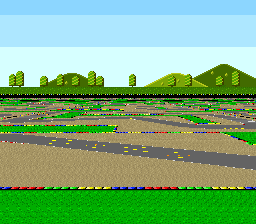
Screenshot
mode7/perspective fakes a receding floor with a precomputed M7A/M7D table. This example asks the DSP-1 for the real thing: every frame the coprocessor's Raster command streams one Mode 7 matrix per scanline — A, B, C and D — for the camera you describe with dsp1SetCamera, and two HDMA channels replay them the next frame. Turn with the D-pad and the whole floor rotates in true perspective, because the rotation is inside the matrices the chip computed.
This is the technique Super Mario Kart and Pilotwings shipped with — the reason the DSP-1 was on the cartridge at all.
How it works
- dsp1SetCamera(&cam) describes the camera and hands back four numbers: Vof (raster of the "imaginary
centre"), Vva (horizon raster, relative to Vof), and Cx/Cy — the ground point under that centre, which goes straight to M7X/M7Y.
- dsp1Raster(ab, cd, Vva + 2, lines) streams the per-raster matrices for the ground below the horizon into two buffers laid out as HDMA_MODE_2REG_2X repeat payloads (M7A/M7B on one channel, M7C/M7D on the other). Raster Vva+1 is the singular horizon line, so the ground starts at Vva+2 on screen line 112 + Vof + Vva + 2.
- Two more HDMA channels do the F-Zero split above the horizon (BGMODE 3 + BG2 sky, then BGMODE 7 + BG1 ground) exactly like mode7/perspective.
- The tables are double-buffered: the DSP-1 fills the back set during active display (≈ 50 µs per raster, 126 rasters ≈ 40 % of the frame), and VBlank swaps them with hdmaSetTable and moves M7X/M7Y and the Mode 7 scroll so the ground under the imaginary centre stays pinned to the middle of the screen.
Moving forward uses the chip too: dsp1Triangle(heading, speed) gives the sin/cos step on the ground plane.
Controls
| Button | Action |
| D-pad Left / Right | Turn the camera (the floor rotates) |
| D-pad Up / Down | Drive forward / backward along the heading |
SNES Concepts
- DSP-1 Raster: an open-ended command that streams until the CPU writes the $8000 sentinel in place of a D read (the lib does this for you)
- Parameter outputs (Vof, Vva, Cx, Cy) as the whole screen geometry
- HDMA 2REG_2X repeat blocks feeding two Mode 7 registers per channel
- Double-buffered HDMA tables swapped in VBlank
- Mid-frame BG mode switch (sky above, Mode 7 below)
How to Build
The ROM needs a DSP-1 on the cartridge (USE_DSP1 := 1 sets the header) and luna needs Sony's dsp1b.rom firmware installed once (luna state --dsp1-rom <path> dsp1_ground.sfc); the luna test manifest is firmware-gated and skips cleanly in CI.
Modules Used
console, dma, background, input, mode7, hdma, dsp1 (auto-added by USE_DSP1)
Project Structure
| File | Purpose |
| main.c | Camera, DSP-1 calls, HDMA tables, double buffering |
| res/ground.png.toml, res/sky.png.toml | the import settings of the Mode 7 ground (mode = 7) and the Mode 3 sky (opensnes-tileset); the build converts and links them, res/*.inc declare the symbols |
| res/ground.png, res/sky.png | Textures shared with mode7/perspective (PVSnesLib Mode7Perspective, mills32 / alekmaul) |
Going Further
- dsp1Target(h, v) is the inverse: which ground point is under a screen pixel — the missile scope of Pilotwings, a cursor on the track.
- Change CAM_AZS (tilt) and watch Vof/Vva move the horizon; keep the ground under 127 rasters per repeat block, or call dsp1Raster twice for two blocks.
- chips/dsp1_cube — the other half of the chip: Attitude / Objective / Project for objects on top of this floor.

 1.16.1