 |
OpenSNES
Modern Open-Source SNES Development SDK
|
|
OpenSNES
Modern Open-Source SNES Development SDK
|
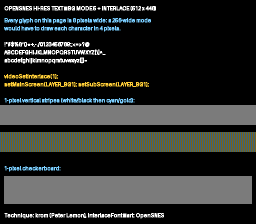
Port of krom (Peter Lemon)'s InterlaceFont demo (PeterLemon/SNES, PPU/Interlace/InterlaceFont). BG Mode 5 renders 512 horizontal pixels with 16×8 tiles; SETINI bit 0 adds screen interlace for 448 visible lines. This example lands the SDK's SETINI surface (videoSetInterlace/ObjInterlace/Overscan/PseudoHires, all composing through a write-only-register shadow) with a text page as the canonical hi-res payload — every glyph is 8 px wide, unrepresentable at 256.
The page is a screen of the Rue basse's terminal, 63 columns of the library's 8x8 font in the city's colours (white, cyan and amber on the glass), drawn and converted to Mode 5's paired-tile format by devtools/art_assets/build.py (hires_page); the outputs are committed. The 1-pixel stripe/checker bands are the acid test: at true 512 px they alternate every column — a 256-wide mode would alias them to flat gray.
Mode 5's 512 columns interleave the sub screen (even columns) and main screen (odd columns) — a period CRT blended adjacent columns into smooth strokes, while a modern LCD's crisp pixel grid shows them individually:
| Register | krom | this port |
|---|---|---|
| BGMODE | $0D (Mode 5, priority, 16×8) | same (setMode(BG_MODE5, 0x08)) — verified $0D in luna |
| SETINI | $01 | same (videoSetInterlace(1)) — verified $01 |
| TM / TS | $01 / $01 | same (setMainScreen+setSubScreen) — verified |
| BG1SC | map word $4000 | same (bgSetMapPtr), 32×64 (krom: 64×32 — his page is wider, ours taller) |
| BG12NBA | tiles word $8000 | same (bgSetGfxPtr) — verified |
The screenshot above is luna's capture at native resolution (luna run --native-res, 512×448: the field pair, every column), and the visual baseline is taken the same way. The full 448-line page displays once with no vertical wrap (the 32×64 map: a 32-row map only covers 256 hi-res lines in interlace).
console, dma, background
| File | What | Made by |
|---|---|---|
| res/text.pic, res/text.map, res/text.pal | the page as Mode 5 reads it: 4bpp tile pairs, a 32×64 map, four colours | devtools/art_assets/build.py (hires_page) |
| res/source.png | the page itself, 512×448, for reference | the same |
CC0, like the rest of the Néo-Lumen assets (assets/neo-lumen/README.md).
The plain Mode 5 picture is this program minus videoSetInterlace(): 512 pixels wide at 256 lines, 16x8 tiles stored as pairs of 8x8 characters (N on the left half, N+1 on the right), loaded with bgInitTileSet() at 4 bpp for BG1 and 2 bpp for BG2. The same two traps apply — the layer shows through main AND sub screen, and the VRAM budget doubles (24 KB of interleaved tiles for one screen).
 1.16.1